
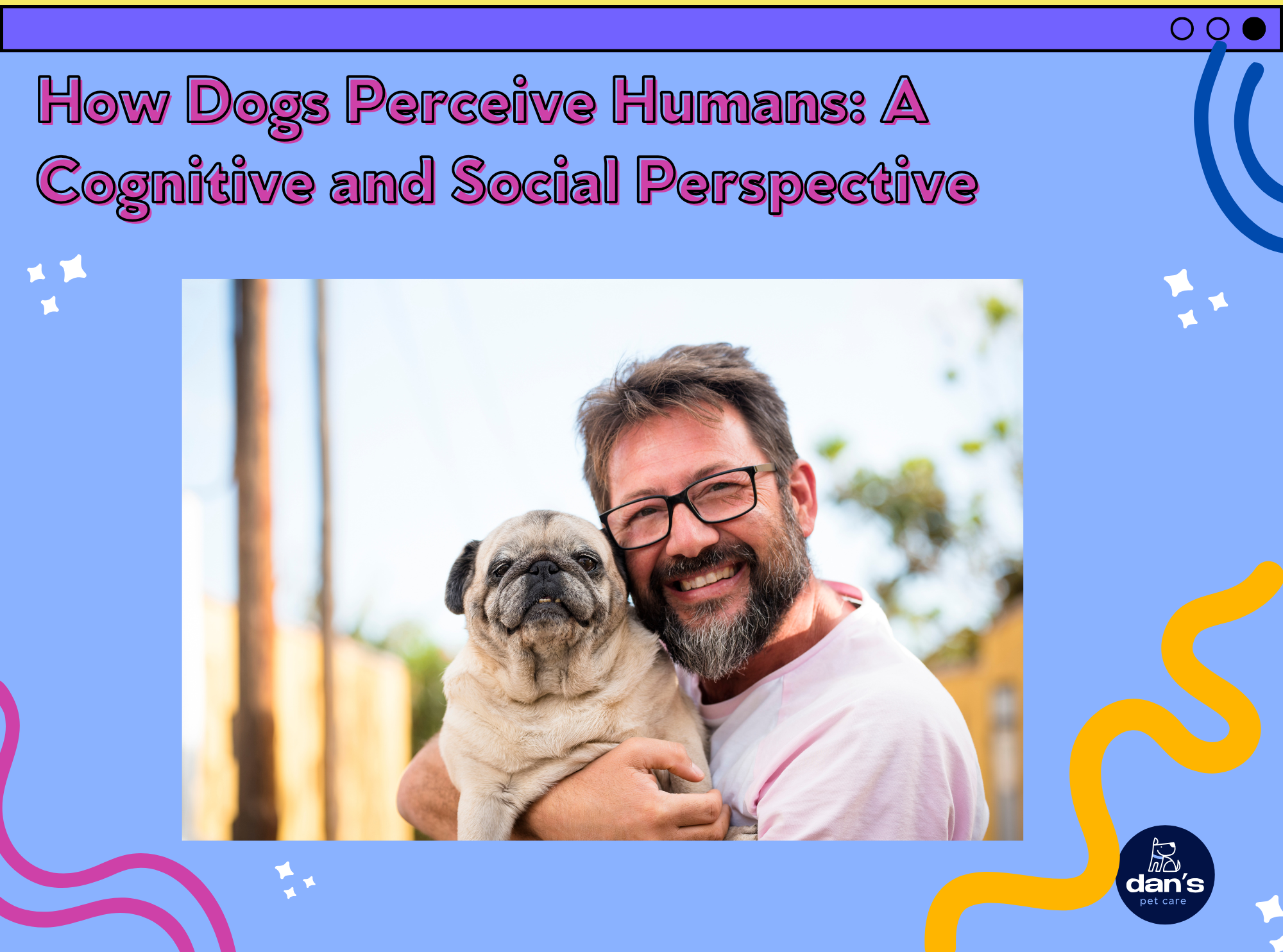
Understanding the Dog’s View
For centuries, humans have wondered how dogs see the world. We know they love us, follow us, and rely on us, but how do dogs actually perceive humans? Recent scientific research has shed light on how dogs understand their owners on both a cognitive and social level. Dogs are not just passive companions; they actively interpret our actions, emotions, and cues in ways that suggest a deep social intelligence. Their perspective goes beyond loyalty. At Dan’s Pet Care, we’ve worked with families across Long Island and seen firsthand how dogs adapt their behavior based on the humans around them. This article explores the fascinating ways dogs perceive us, not just as pet parents, but as fellow social beings. For expert care rooted in this understanding, visit Dan’s Pet Care.
Dogs See Us as Social Partners
Dogs are one of the few non-human species that view humans as social companions. Research shows that dogs treat their human caregivers much like a fellow pack member. This social bond is similar to the attachment a child forms with a parent. Dogs seek guidance, comfort, and reassurance from their humans. They also develop loyalty based on consistent interactions and emotional responsiveness. Unlike wolves or even other domesticated animals, dogs are uniquely adapted to live in our homes and adapt to our daily rhythms. They prefer human companionship over solitude and may experience separation anxiety when left alone.
This perspective influences how they respond to training, routines, and discipline. Understanding that dogs consider us integral to their social structure can help pet parents build stronger, more responsive relationships with their pets.
How Dogs Recognize Human Faces
Dogs are excellent at recognizing human faces. Studies using brain scans show that a dog’s brain responds more strongly to human faces than to other dogs or objects. Dogs use facial recognition to identify familiar people, read emotions, and anticipate actions. They’re especially good at interpreting our eyes, which is why direct eye contact plays a key role in bonding. Dogs can distinguish between happy, angry, and neutral expressions, often altering their behavior in response. A smile may invite interaction, while a frown may prompt caution. This ability helps dogs navigate social environments and understand the emotional tone of their household. Long Island pet parents often report that their dogs “know” when they’re sad or stressed, and science backs this up. Dogs aren’t just looking at us. They’re truly seeing us.
Dog facial recognition skills:
Identify individual people by face
Read emotional expressions
React to visual social cues
Dogs Interpret Human Emotions
One of the most remarkable aspects of dog cognition is their ability to sense and respond to human emotions. Dogs can pick up on our mood changes through vocal tone, body language, and even scent. When we’re happy, they often respond with excitement. When we’re sad or anxious, they may become subdued or offer comfort. This empathetic response stems from thousands of years of co-evolution. Dogs evolved to live alongside humans and benefit from understanding our emotional states. Functional MRI studies show dogs process emotional sounds in a similar way to humans, especially those of sadness and distress.
Their ability to detect cortisol and adrenaline in our scent also helps them anticipate changes in mood. Dogs don’t just observe our feelings, they feel them. This deep emotional resonance makes them exceptional companions and even more effective therapy animals.
Dogs Understand Human Gestures and Language
Dogs are experts at reading human body language. They can follow pointing gestures, interpret head direction, and even understand some spoken words. While dogs may not grasp language like humans do, they associate certain words with actions, objects, or emotions. Words like “walk,” “treat,” or “car ride” often elicit strong reactions. Beyond vocabulary, dogs rely heavily on non-verbal cues. They watch our posture, hand movements, and facial expressions to gauge our intentions. Research suggests dogs understand these gestures better than even chimpanzees. This ability to decode human communication makes training and bonding much easier. Long Island families working with Dan’s Pet Care often note how quickly dogs adapt to their routines. With consistent cues and reinforcement, dogs learn to anticipate our behavior and respond with loyalty and enthusiasm.
Cues dogs understand:
Pointing and hand signals
Tone of voice
Common words and phrases
Eye and head direction
Dogs Use Scent to Learn About Us
While we rely mostly on sight, dogs primarily experience the world through smell. A dog’s sense of smell is estimated to be tens of thousands of times more sensitive than ours. They use scent not just to explore their environment, but also to learn about people. Each human has a unique scent profile that dogs can identify and remember. Dogs can detect hormonal changes, such as fear or excitement, simply by sniffing us. They may also sense illness, pregnancy, or stress through subtle chemical changes. Some dogs are trained to detect seizures or diabetes by smell alone. This powerful sensory ability enhances their perception of humans, adding a layer of understanding we don’t even notice.
At Dan’s Pet Care, we’ve seen many Long Island pets respond to emotional and physical changes in their owners before any outward signs were visible.
Dogs Form Mental Maps of Their Environment
Dogs have a sophisticated spatial awareness that allows them to form mental maps of their environment and the people within it. This means they remember the locations of rooms, objects, other animals, and humans. They also track movement patterns and daily routines. This is why your dog knows where to wait for you when you come home or when to head to the door before a walk. Their perception isn’t limited to physical space, it includes social positioning too. Dogs notice who leads, who follows, and who gives commands. They use this information to navigate household dynamics and adjust their behavior. Understanding your dog’s internal map can help improve training and reduce anxiety, especially during changes like moving or new household members. Dogs don’t just live in our homes. They understand them.
Dogs Form Opinions About People
Dogs don’t just see people as one uniform group, they form opinions about individuals based on experience. Research shows dogs can judge human intentions and behavior. They’re more likely to trust and cooperate with people who are kind, helpful, or consistent. In one study, dogs avoided people who refused to help their owners. This ability to assess character highlights the depth of their social intelligence. Dogs also remember past interactions, whether positive or negative. This is why they may be wary of a particular visitor or overly excited to see a familiar friend. These opinions shape their willingness to engage and can influence long-term behavior. At Dan’s Pet Care, we emphasize respectful, consistent care so dogs can build trust over time. The more positive interactions a dog has, the more socially confident they become.
Dogs may judge based on:
Body language and tone
Past behavior and treatment
How someone interacts with their owner
Dogs Mirror Our Behavior
Dogs are social learners, meaning they often mirror the behavior and energy of the people around them. This is especially true in multi-person households where dogs observe interactions and adapt their responses. A calm home may result in a calm dog, while a chaotic or stressful environment may lead to anxiety. This mirroring also applies to activity levels, mood, and vocal cues. Dogs learn routines quickly and internalize patterns of behavior. If you’re active and engaged, your dog will often mirror that energy. If you’re sedentary or inconsistent, your dog may become restless or unsure. This behavioral mirroring reinforces the idea that dogs perceive us as more than just providers, they see us as emotional and behavioral models. Creating a stable, positive atmosphere is essential for a happy, balanced pet.
Dogs Adjust Based on Social Context
Dogs are incredibly adept at adjusting their behavior based on social context. They act differently with children than adults, with strangers versus family members, and in public versus private settings. This adaptability shows that dogs are constantly assessing their environment and modulating their responses. A dog might be gentle and reserved with a toddler but playful and energetic with a teen. They may become protective when a stranger enters the home but relaxed during a quiet evening. These adjustments reflect a high level of social intelligence. Dogs evaluate tone, energy, and past experiences to guide their actions.
Long Island families often comment on how “in tune” their dogs are with household dynamics. At Dan’s Pet Care, we help owners understand and support this adaptability, ensuring that dogs feel secure and understood in all settings.
Dogs Understand Fairness and Expectations
Dogs not only understand social roles, but they also have a sense of fairness. Studies show that dogs respond negatively when they see another dog receiving a reward for the same task they performed without recognition. This sensitivity to equity and reward systems is part of their cognitive toolkit. Dogs also build expectations around routines, meals, and attention. When these expectations are consistently met, dogs feel secure. When they are disrupted, dogs may exhibit confusion or frustration. Understanding this cognitive framework helps pet owners maintain consistency, which is key to building trust.
Dogs thrive in structured environments where behavior leads to predictable outcomes. This concept of fairness and expectation also plays a role in how dogs perceive their owners, as leaders who set the rules but also recognize effort.
Dogs See Us as More Than Owners
Dogs don’t just see us as food providers or leaders. They perceive us through a rich combination of sensory, emotional, and cognitive signals. They analyze our expressions, listen to our words, track our routines, and respond to our moods. They form opinions, build expectations, and adapt to social settings with remarkable flexibility. At Dan’s Pet Care, we celebrate this extraordinary perspective and help Long Island pet owners nurture deeper, more empathetic relationships with their dogs. Understanding how dogs view us allows for better communication, trust, and mutual respect. They are more than pets, they are social partners who truly see us. To learn more or receive personalized care that respects this unique bond, visit Dan’s Pet Care.